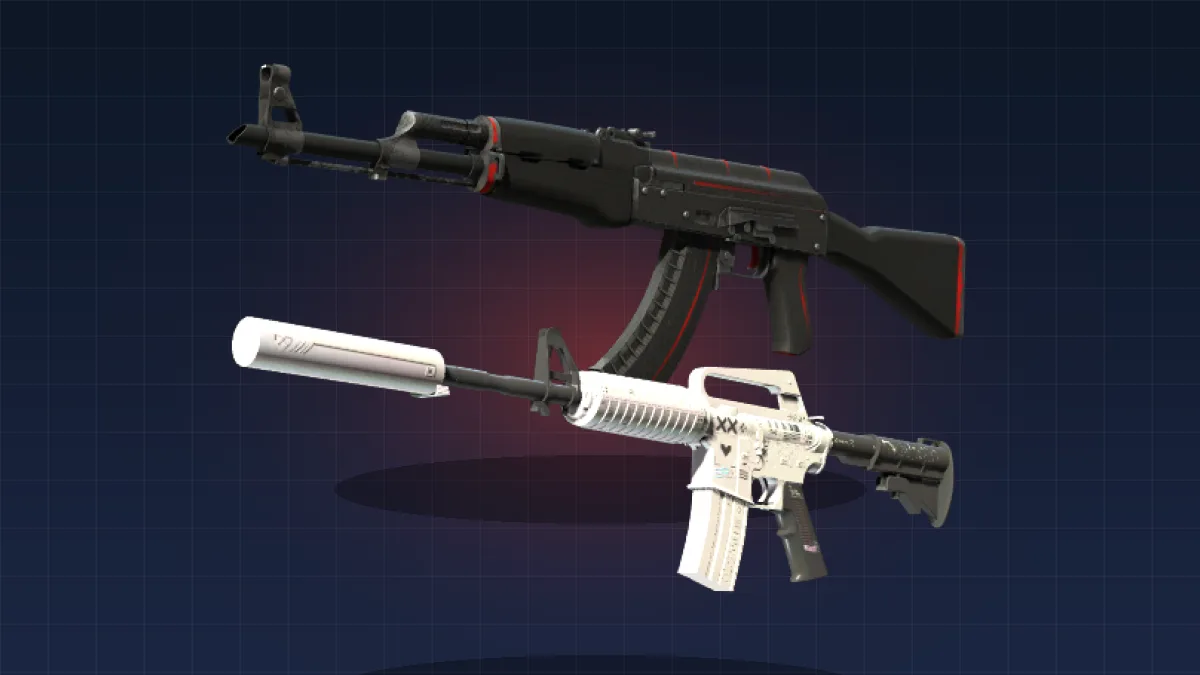
Pull up two Field-Tested AK-47 Redlines on any marketplace and you'll often see two noticeably different prices. Same skin, same wear label. The difference is a single number most new traders never look at: one has a float of 0.151, the other 0.37. The first looks almost Minimal Wear. The second looks like it's been dragged behind a truck.
Float is the most important detail on a CS2 skin after the name itself, and it's simpler than it looks. Here's how it works, how it interacts with pattern index, where the price premiums come from, and how to check both before you trade, buy, or deposit an item on a gambling site.
What a float value is
Every CS2 skin has a wear value, universally called its float, between 0 and 1. It's set once, when the item is created, and it never changes. Using a skin in matches doesn't wear it down, whatever your friend who refuses to equip his knife says. A 0.02 Karambit will be a 0.02 Karambit forever.
The float decides how much of the wear texture shows on the paint: scratches, faded edges, chipped areas. Lower means cleaner. Steam shows you the wear category, but the float is the precise version, usually displayed to many decimal places.
The five wear ranges
| Wear | Float range | Share of the 0 to 1 scale | What it usually looks like |
|---|---|---|---|
| Factory New (FN) | 0.00 to 0.07 | 7% | Clean, sharp paint |
| Minimal Wear (MW) | 0.07 to 0.15 | 8% | Light scuffs, often hard to spot in game |
| Field-Tested (FT) | 0.15 to 0.38 | 23% | Visible wear, varies a lot across the range |
| Well-Worn (WW) | 0.38 to 0.45 | 7% | Heavy scratching and fading |
| Battle-Scarred (BS) | 0.45 to 1.00 | 55% | Large patches of missing paint |
Two things worth taking from that table. First, Battle-Scarred covers more than half the scale, so "BS" can mean very different things: a 0.46 and a 0.98 of the same skin can look nothing alike. Second, Field-Tested is wide too. A low FT (0.15 to 0.18) and a high FT (0.35 to 0.38) are effectively different items for anyone who cares how the skin looks.
Float caps: why some skins skip wear levels
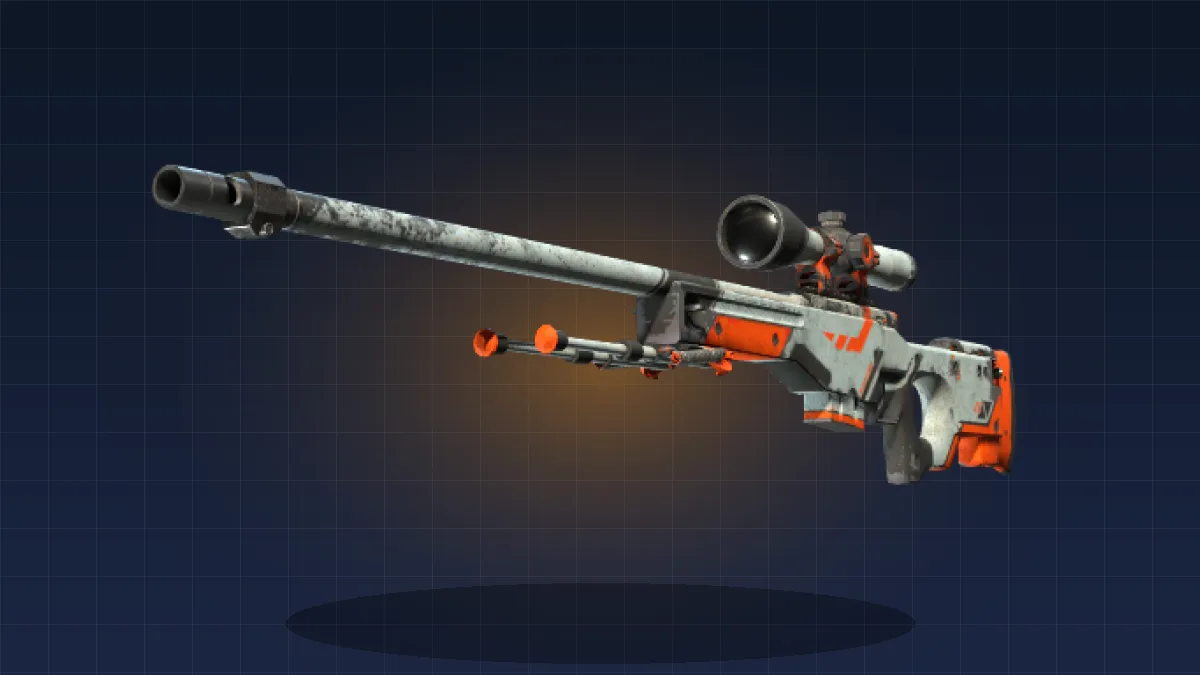
Not every skin uses the full 0 to 1 scale. Each skin has its own minimum and maximum, and that's why you'll never find a Factory New AWP Asiimov.
Some well-known caps:
- AWP Asiimov: 0.18 to 1.00. Only exists in Field-Tested, Well-Worn and Battle-Scarred.
- AK-47 Redline: 0.10 to 0.70. No Factory New, and a 0.10 Minimal Wear is the best possible copy.
- Doppler and Fade knives: 0.00 to 0.08. Factory New or Minimal Wear only, and Minimal Wear copies are rare.
- Case Hardened: the full 0.00 to 1.00.
When a skin is created, its float lands somewhere inside its own range. Spread evenly across the range, here's how much of it falls into each wear for two capped skins:
| Skin (range) | MW | FT | WW | BS |
|---|---|---|---|---|
| AWP Asiimov (0.18 to 1.00) | None | (0.38 - 0.18) / 0.82 = 24.4% | 0.07 / 0.82 = 8.5% | 0.55 / 0.82 = 67.1% |
| AK-47 Redline (0.10 to 0.70) | 0.05 / 0.60 = 8.3% | 0.23 / 0.60 = 38.3% | 0.07 / 0.60 = 11.7% | 0.25 / 0.60 = 41.7% |
Treat those as the share of each range, not exact drop odds. Community tracking suggests floats aren't spread perfectly evenly when items drop, and the very bottom of any range is rarer than a flat split would imply. The point is the shape: for an Asiimov, Field-Tested covers less than a quarter of the possible floats, which is part of why FT Asiimovs hold a premium over Battle-Scarred ones.
Why low floats sell at a premium
The premium for a low float within the same wear tier comes from a few different places, and it helps to know which one is driving the price on a skin you're looking at.
It looks better. On skins where wear shows clearly, like the Redline's black paint or anything with white sections, a low float is visibly cleaner in game. Buyers pay for that directly.
Collectors chase rankings. Float databases rank every tracked copy of a skin. Owning one of the lowest floats in existence (a 0.000-something, or a top-ten copy) is a niche hobby with real money behind it. At that end of the market, prices are set by a handful of collectors, not by any price guide.
Trade-up demand. In a trade-up contract, the float of the output depends on the floats of the inputs. Crafters who want a Factory New result need low-float inputs, so cheap skins with very low floats sometimes sell for several times the price of a normal copy. This demand got bigger after October 2025, when Valve let players trade up five Covert skins into a knife or gloves, and people started crafting toward clean knives.
It's at the cap. For capped skins, the float closest to the minimum (0.10 on a Redline, 0.18 on an Asiimov) is the best version that can exist, and collectors price it that way.
Here's how listings of a single mid-tier rifle skin often stack up. The numbers are illustrative, based on a Field-Tested copy around $20, and the ratios vary a lot from skin to skin:
| Copy | Float | Rough price | Why |
|---|---|---|---|
| High FT | 0.36 | $19 | Baseline FT, wear clearly visible |
| Mid FT | 0.25 | $20 | Normal FT price |
| Low FT | 0.152 | $23 to $25 | Looks close to MW for less money |
| Normal MW | 0.11 | $30 | Next wear tier |
| Low MW | 0.071 | $33 to $36 | Almost FN visually |
| Normal FN | 0.04 | $55 | FN tier price |
| Very low FN | 0.002 | $90 or more | Collector and trade-up demand |
The best value on that list is the low Field-Tested. You get most of the look of a Minimal Wear for close to the Field-Tested price. That pattern holds on a lot of skins, and it's the first thing we tell people who want a clean-looking loadout on a budget.
One catch on the other end of the table. Premium floats are slower to sell. An ordinary Field-Tested copy can usually be sold within minutes at the going rate, because hundreds of people want one. The 0.002 Factory New needs a buyer who specifically cares about that number, and there may only be a handful at any given time. If you buy a premium float, expect to either wait for the right buyer or accept less than the asking price when you sell. Treat the premium as something you pay for your own enjoyment, not as an investment that's guaranteed to come back.
When float doesn't matter (or high floats win)
Some skins barely change across their range. Simple patterns, dark finishes and anything with very little paint on the visible side can look almost the same from Factory New to Minimal Wear, and sometimes into Field-Tested. Paying a premium for a low float on one of those is paying for a number nobody will see. Check screenshots or inspect the item before you pay extra.
And sometimes the high end wins. The best-known example is the "Blackiimov": AWP Asiimovs at very high floats, where the white paint has worn away so badly the rifle looks mostly black. The most extreme copies sell well above a normal Battle-Scarred Asiimov because they look unique. A few other skins have similar fan followings at max float.
Pattern index: the other number that matters
Every skin also has a pattern index, shown in game as the pattern template, with roughly a thousand possible values. It decides where the texture sits on the weapon model: which part of the image lands on the slide, the magazine, the blade.
For most skins, pattern is irrelevant. For a few, it's worth more than the float:
- Case Hardened. The pattern decides how much blue shows. "Blue gem" patterns can be worth many multiples of an ordinary copy. The AK-47 Case Hardened with pattern 661 is the most famous example in the game.
- Fade. The pattern decides the fade percentage, how much of the item carries the full color gradient. Higher-percentage fades sell for more.
- Marble Fade knives. Certain patterns produce the "fire and ice" red-and-blue look that collectors pay well for.
- Crimson Web. On knives and gloves, the number and placement of webs matters. Centered webs on visible surfaces carry a premium.
Doppler phases (Phase 1 to 4, Ruby, Sapphire, Black Pearl, and Emerald on Gamma Dopplers) are a separate thing. Phases are different finishes, not patterns, though within a phase the pattern still changes how the item looks.
How to check a float before you buy
In game. Inspect an item from your inventory and the item info panel shows its wear rating (the float) and pattern template. That's the most reliable source for anything you already own.
On third-party marketplaces. Every major skin marketplace shows float and pattern on each listing, often with screenshots. If you're shopping, this is the easiest place to compare copies.
On the Steam Market. Historically, listings didn't show float, and most traders used an inspect link or a float-checking browser extension. Valve has been testing a Market redesign in 2026 that shows wear and pattern details directly on listings, which makes extensions less necessary. Until that's on every page you use, inspect before you buy anything where float matters.
On gambling sites. This depends on how the site sources items. On P2P withdrawal marketplaces, such as the ones on CSGOEmpire and CSGORoll, listings generally show the float, so you can pick the cleanest copy at a given price. On many case-opening sites, the float of a withdrawn item is whatever copy the site or its supplier has available. Don't expect a nice float from a case you opened on a site, and don't pay a premium for one you can't choose. Our P2P vs bot deposits guide explains why the two systems behave so differently.
Float and gambling sites: what to keep in mind
A few practical consequences if you move skins between gambling sites and marketplaces:
- Your deposit value ignores float. Most sites value deposits from market data by name and wear. A low-float item gets the same credit as an average one, so you lose the premium. Deposit average copies, keep special ones.
- Withdrawals are a chance to pick well. If a site's withdrawal list shows floats, a low-FT copy at FT price is free value.
- Case "values" are average-copy values. The price a site shows for a skin in a case assumes an ordinary float. A Battle-Scarred AWP from a case might be a 0.46 or a 0.99, and on most sites you get what you get. Our case odds explainer covers how those item values feed into expected value.
- Market prices move independently of float. The premium for a good float is a percentage on top of the base price. If the base price drops, the premium shrinks with it. Our guide to how CS2 skin prices work covers what moves the base.
Before you buy: a float checklist
- Look up the skin's float range. If it's capped, know what the best possible copy is.
- Decide whether wear is actually visible on this skin. If it isn't, buy the cheapest float in the tier you want.
- If it is visible, look at the low end of the tier below. A 0.15 to 0.17 FT is usually the best value on the board.
- Check the pattern for Case Hardened, Fade, Marble Fade and Crimson Web items. On anything else, ignore it.
- Compare the same float band across at least two marketplaces before paying a premium.
- Never deposit a special float or pattern to a site that prices by name and wear.
Float hunting is one of the more relaxed corners of the skin hobby. Just keep it separate from gambling. A clean skin you bought on purpose holds its value far better than a pile of site balance does.