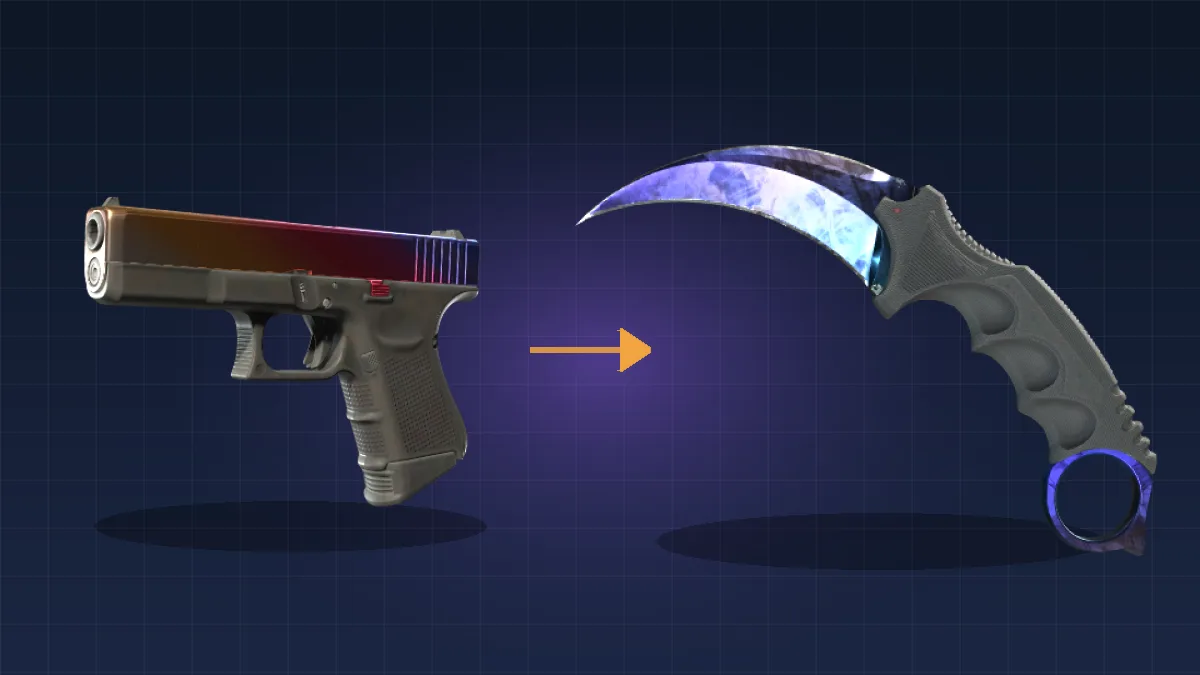
0.26%. That's the chance of a knife or gloves from an official CS2 case, and most players can recite it. Far fewer have worked out what it costs to chase, or how it compares with the cases on gambling sites, which run on completely different rules.
This guide does both, with the math written out so you can redo it for any case you're looking at. Nothing here needs more than multiplication and, in one place, an exponent.
Valve's published odds
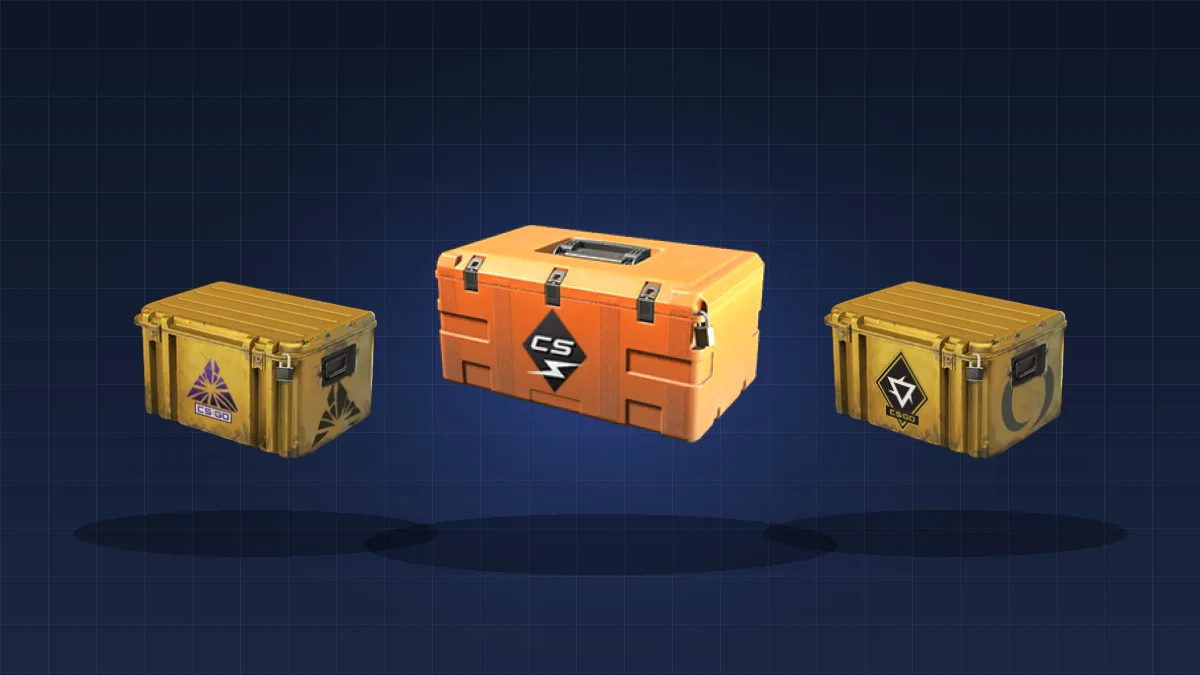
Valve began publishing case odds in 2017 to comply with rules in China, and the numbers haven't changed since. Every official weapon case uses the same rarity split:
| Rarity | Color | Chance per opening | Roughly 1 in |
|---|---|---|---|
| Mil-Spec | Blue | 79.92% | 1.25 |
| Restricted | Purple | 15.98% | 6.3 |
| Classified | Pink | 3.20% | 31 |
| Covert | Red | 0.64% | 156 |
| Exceedingly Rare (knife or gloves) | Gold | 0.26% | 385 |
Within a rarity tier, each skin in the case is generally understood to be equally likely. Each drop then gets a random float within that skin's range (our float values guide covers how that works), and about one in ten weapon drops comes out StatTrak.
The important structural point: Valve's odds are set per tier, not per item. Valve doesn't decide that a particular skin should be rare because it's valuable. The market decides what each tier's skins are worth after the fact. That's very different from how gambling sites build cases.
What an official case actually returns
Opening an official case costs a key ($2.49 in the US Steam store, regional prices vary) plus the case itself, which you usually buy on the Market. Here's a worked example with a hypothetical case priced at $0.50. The average values per tier are made up but in a realistic ballpark for an older case:
| Tier | Chance | Average skin value | Contribution to EV |
|---|---|---|---|
| Mil-Spec | 79.92% | $0.20 | $0.16 |
| Restricted | 15.98% | $1.20 | $0.19 |
| Classified | 3.20% | $5.00 | $0.16 |
| Covert | 0.64% | $25.00 | $0.16 |
| Exceedingly Rare | 0.26% | $300.00 | $0.78 |
| Expected value | $1.45 |
You pay $2.99 (key plus case) and get back $1.45 worth of skins on average, a 48.5% return. And those are Steam Market prices. Sell the skin on the Market and the 15% fee means you receive about 87% of the listed price, so your realized return drops to about $1.26, or 42% of what you spent. It's also Steam Wallet money, which you can't withdraw. Our article on how CS2 skin prices work covers why that matters.
Look at where the value sits. More than half the case's expected value ($0.78 of $1.45) comes from an event that happens 0.26% of the time. For 99.74% of openings, you're playing for a lot less than the headline average. The single most likely result, by a mile, is a Mil-Spec worth about a fifth of a key.
The key is the part people forget to price in. At $2.49 it's a fixed cost on every opening, so on cheap cases it's most of what you pay: in our example, 83% of the $2.99 goes on the key. A case only becomes a large part of the cost once it's left the active drop pool and become scarce, and by then its price usually reflects how good its contents are, so the math rarely gets better. The case price and the key move separately, but you need both, every time.
Your numbers will differ case to case. A case whose knives are in high demand can have a much better EV than an old one full of unloved finishes. But we haven't seen an official case where opening at retail beats selling the case unopened over any long stretch.
How gambling-site cases work
Gambling-site cases aren't Valve cases. They're item lists the site builds itself. The site picks the items, assigns each one a probability, prices the items with its own price list, and then sets the case price above the expected value. The gap is the house edge.
There are no rarity tiers and no fixed split. A site can put a knife at 0.1% or at 0.001%, and it can fill the rest with whatever keeps the math where it wants. So the odds table is the only way to know what you're buying. Below is a hypothetical $10 case of the kind you'll see on most case-opening sites:
| Item | Site value | Chance | Value × chance |
|---|---|---|---|
| Butterfly Knife | $1,200.00 | 0.10% | $1.20 |
| AWP skin | $150.00 | 0.60% | $0.90 |
| AK-47 skin | $45.00 | 3.00% | $1.35 |
| Desert Eagle skin | $12.00 | 12.00% | $1.44 |
| USP-S skin | $7.00 | 30.00% | $2.10 |
| MP9 skin | $4.00 | 54.30% | $2.17 |
| Expected value | 100% | $9.16 |
Turning the table into a house edge
Three numbers tell you most of what you need:
- Return to player (RTP) = expected value ÷ case price = $9.16 ÷ $10 = 91.6%.
- House edge = 100% minus RTP = 8.4%, or 84 cents per opening on average.
- Chance of a profitable opening = add up the chances of every item worth more than the case: 0.1% + 0.6% + 3% + 12% = 15.7%.
That last number is the one people don't calculate, and it's the one that matches how the case feels to open. On average you get 91.6% back, but 84.3% of openings lose money, and more than half of them hand you an item worth 40% of what you paid. The average is held up by rare hits you probably won't see in a normal session.
Over many openings, expected loss is simple: openings × price × house edge. A hundred openings of this case: 100 × $10 × 8.4% = $84 expected loss. The actual result could be anywhere from a few hundred dollars down to a big win if the knife lands, but $84 is where it centers.
What 100 openings really look like
Averages are easy to quote and hard to feel. So we simulated 50,000 runs of 100 openings of that same $10 case, $1,000 wagered per run:
| Outcome | Result after 100 openings |
|---|---|
| Expected (the math) | -$84 |
| Bad run (10th percentile) | -$352 |
| Below-average run (25th percentile) | -$296 |
| Typical run (median) | -$205 |
| Above-average run (75th percentile) | -$83 |
| Good run (90th percentile) | +$206 |
| Runs that finish ahead | About 16% |
The typical player loses more than twice the expected amount, because the average includes the lucky few who hit the knife or the AWP. Roughly half of all 100-opening runs never see either of the two top items at all. If you open this case a hundred times and lose $200, nothing went wrong. That's the median outcome.
The price list matters as much as the odds
The site values its items with its own price list, and that list isn't always the price you'd get if you withdrew and sold the item. If the site's values run 5% above what the items fetch on a cash marketplace, the real return on our example case is 91.6% ÷ 1.05 = 87.2%. Before you trust any RTP figure, check a few of the case's items against a real marketplace. If the site lets you sell items back to balance at the listed value, that's the price that matters for replaying; if you plan to withdraw, the market price is.
How many openings until the knife?
The odds of hitting an item at least once in a run of openings is 1 minus the chance of missing every time: 1 − (1 − p) raised to the number of openings. For three common probabilities, it works out like this:
| Openings | Item at 0.10% (our site knife) | Item at 0.26% (Valve gold) | Item at 0.64% (Valve Covert) |
|---|---|---|---|
| 50 | 4.9% | 12.2% | 27.5% |
| 100 | 9.5% | 22.9% | 47.4% |
| 385 | 32.0% | 63.3% | 91.6% |
| 1,000 | 63.2% | 92.6% | 99.8% |
| Openings for a 50% chance | 693 | 267 | 108 |
Two things to take from this. First, "1 in 385" is not a schedule. After 385 Valve openings, more than a third of people still haven't seen gold. Second, the cost of a coin flip's chance is big. Getting to a 50% chance of a Valve knife takes about 267 openings, which at $2.99 each is roughly $800 in keys and cases. On our $10 site case, a 50% shot at the Butterfly means 693 openings, $6,930 wagered and an expected loss of about $580 on the way.
Also: each opening is independent. Missing for 300 openings doesn't make the next one more likely to hit. Nothing is "due".
Valve cases vs site cases, side by side
| Official Valve case | Gambling-site case | |
|---|---|---|
| Odds set by | Rarity tier, same for every case | The site, per item |
| Typical return | Often well under 50% of the cost to open | Usually much higher, but varies by case and site |
| Item values | Set by the market after release | Set by the site's price list |
| What you win | A skin in your Steam inventory | Site balance or a withdrawable skin |
| Can you verify the roll? | No | Yes, on provably fair sites |
| Cash out | Only through Steam Wallet or third-party markets | Depends on the site's withdrawal methods |
Here's my honest take. Official cases are a bad bet, and almost everyone opening them knows it. People open them for the experience, to support a case they like, or to roll for a specific skin. Gambling-site cases usually return more per dollar and their rolls can be checked, which is genuinely better. But they're built to be opened fast and repeatedly, with balance you can reinvest in one click. A 92% case opened 200 times in an evening costs more than a 48% case opened twice. The return rate isn't the whole story. Your pace is the other half.
Tricks to watch for in site odds tables
- Rounded or hidden small odds. A top item listed at "<0.01%" could be 0.009% or 0.0001%. If the exact figure isn't shown, assume the low end.
- Headline items as decoration. A $10,000 knife at a vanishingly small chance makes the case look exciting and barely moves its EV. Do the math with the realistic items.
- "Up to" marketing. "Win up to $5,000" tells you nothing about the return.
- Price lists above the market. As shown above, inflated item values make RTP look better than it is.
- Odds that change. Some sites adjust case contents over time. Recheck a case you haven't opened in a while.
- Free and level cases. These are marketing and usually have a very low EV. Fun, but not a reason to deposit.
On case-focused sites such as Hunt.gg or Key-Drop, the case page is where you'd look for the item list and its percentages. Get in the habit of opening it before the case itself. If a case doesn't show its odds, treat that as your answer.
Sites that show full item odds and let you verify every roll are doing the minimum right. Our provably fair guide shows how to check a roll against the odds table by hand. If you like the upgrade route instead, the same math applies, and our piece on skin upgrader odds walks through it.
Checking a case in three minutes
Before you open a new case on any site, do this:
- Find the odds table. If the site doesn't publish one, skip the case.
- Multiply each item's value by its chance, and add them up. That's the EV.
- Divide the EV by the case price. Anything below about 85% is expensive. Compare it with other cases on the same site, because the spread can be wide.
- Add up the chances of every item worth more than the case price. That's how often an opening will feel like a win.
- Check three or four item prices against a real marketplace.
- Decide how many openings your budget covers and multiply by price × house edge. That's what the session will cost you on average.
Then set that budget and stick to it. Case opening on these sites is for adults only, and if you find yourself chasing a "due" knife, our responsible gambling page is the place to start. For a broader look at the mode and which sites handle it well, see our case opening guide.